We bring together expertise in engineering, education, encouragement, enforcement and evaluation.
Services
We offer:
Road Safety Assessments
Recommendations
Training
Evaluation
Our Services
Engineering
This encompasses the application of high impact & cutting-edge researched solutions in safe roadway designs, construction, signing, maintenance and casualty reduction techniques aimed at effective sharing of the roadways by all users. Road safety analysis can be conducted for the locations such as:
Intersections
Sections
Bridges
Work Zones
Roads should be conducive for usage by motorists, cyclists and pedestrians of all ages and abilities.
The company’s goal is to ensure the safety of all road users in Zimbabwe by introducing programmes that provide continuous monitoring of the collision/crash data and recommending effective improvements to the roadways.
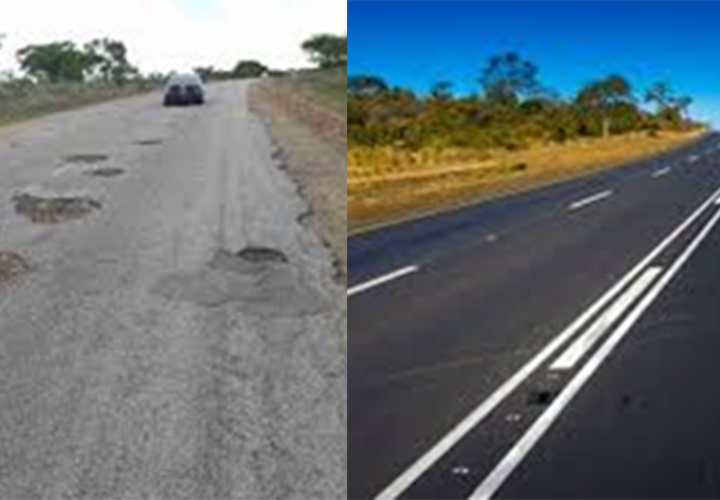
Image depicts potholes at the 585-kilometre peg along the Masvingo-Beitbridge Highway as at 01/11/2018 (before treatment) and the same stretch of the Highway on 03/01/2023 (after treatment).
Education
Road safety education should be introduced in the school curriculum starting at Early Childhood Development (ECD) to University level. Selected Tertiary Institutions should offer Certificates, Diplomas and Degrees in road safety.
The image depicts Early Childhood Development pupils of Greater Heights Academy Junior School being taught how to cross the road. They stopped to allow a commuter omnibus to pass through under the guidance of their teacher. This is as it should be in order to enhance road safety.
Catch them young, so goes the adage. Image depicts Early Childhood Development pupils being guided to cross Gairezi Road by their teacher. Courtesy of Greater Heights Academy Junior School, 660 Gairezi Road, New Marimba Park, Harare. Road safety from cradle to the grave.
Encouragement (Road safety campaigns):
Road users should constantly (January to December) be encouraged to conform to road safety measures. Road safety campaigns should be well planned (data based) in order to address problems at hand by employing the following;
Involvement of politicians
Involvement of religious leaders
Involvement of traditional leaders
Involvement of Medical Practitioners
Involvement of communities
Involvement of stakeholders such as transport organizations
Media houses
Magazines
Familiarization tours to stakeholder institutions
Films and dramas
Leaflets
Diana - The Princess of Wales was killed on 31 August 1997 in a car crash while trying to outrun the Paparazzi in Paris, France. The Princess and her companion, Dodi Fayed were reported not to have been wearing seat belts (as required by the French Law) at the time of the crash. Had she been wearing a seat belt, she could have survived. Safety belts do not trap its wearer but rather protects.
Enforcement:
According to Slavik (1988), the basic purpose of an enforcement scheme is to convert violation – the better alternative as perceived by a violator into the poorer option. The conversion of the better alternative into the poorer one is achieved by two means, that is,
(i) The magnitude of the penalty applied when a violator is apprehended. If the penalty is heavy and deterrent enough, an enforcement scheme is enhanced since it discourages violators from committing violations. (ii) The intensity of an enforcement scheme is represented by the detection rate or hit rate. A 70% or better hit rate turns violators into conformers. If a motorist violates a traffic law ten times, he/she should be caught and dealt with in no less than seven times. It should however be observed that the magnitude of the penalty and the hit rate are factors working in the same direction.
In Zimbabwe however, a convicted cattle thief gets a mandatory nine-year jail term per count whereas a drunken driver who kills a pedestrian is fined USD200/ZiG equivalent or sentenced to 200hours community service.
Enforcement of traffic laws is not only necessary for the purpose of dealing with deliberate offenders. It is also needed because experience shows that, unless such enforcement is maintained, the general level of law observance by the public will deteriorate.
Therefore, enforcement of traffic laws should be an integral element of the collision/crash reduction programme. Among other things, a successful enforcement scheme calls for careful planning by the law enforcement agencies using traffic contraventions and collisions/crashes data. For example, areas and times in which enforcement should be intensified should be determined by a study.
Effective traffic enforcement techniques should be employed in order to achieve road safety.
This is not effective traffic enforcement!
Photograph depicts a commuter omnibus carrying passengers and driving against one-way along Chinhoyi Street, Harare (16/07/2022)
Evaluation:
Evaluation is key in ascertaining whether the effort directed towards realising the desired results in addressing the five Es is paying off. All serious and fatal road traffic collisions/crashes should be investigated by qualified scientific road traffic collision/crash investigators using the laws of motion and friction in order to ascertain the actual cause of the road traffic collision/crash. Effective technological monitoring of treated locations will provide the results needed to determine if a treatment is effective.
The number of deaths and mutilations we tolerate on our public highways is a measure of the value we place on human life and limb (Cohen and Preston [1968:15]).
Image depicts potholes at the 585-kilometre peg along the Masvingo-Beitbridge Highway as at 01/11/2018 (before treatment) and the same stretch of the Highway on 03/01/2023 (after treatment).